
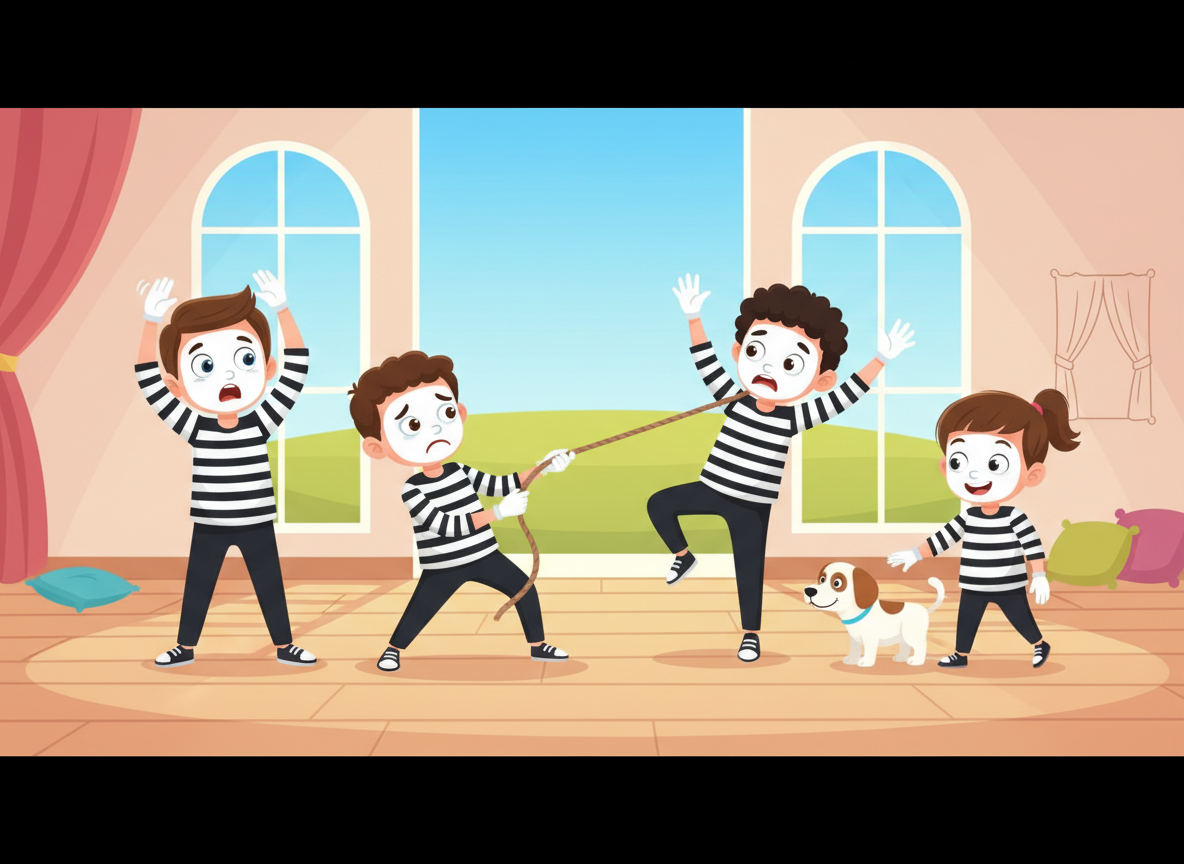
Looking for mime ideas for kids? This practical mime workshop gives teachers, drama leaders and parents a complete collection of mime games, warm-ups and activities that can be adapted for different ages. Mime develops imagination, observation, concentration, physical control and confidence — and you need very little equipment to get started.
What Is Mime?
Mime is storytelling and communication without spoken words. Performers use facial expression, gesture, body language, movement and stillness to show characters, objects, emotions and situations. For children, it is an accessible way into drama because there are no lines to learn.
Mime Warm-Ups
Be a Star: Lie on your back with your arms and legs stretched out. Stretch the whole body as though making a star, then let the star collapse and feel the tension disappear.
Be Hercules: Imagine a heavy weight is pressing your whole body into the floor. Hold the tension, then imagine the weight suddenly disappearing and allow your body to relax.
Shake Off the Ants: Imagine ants crawling all over you. Wiggle and shake different parts of your body until the last imaginary ant has gone, then relax.
Rubber Puppet: Imagine invisible strings are attached to your shoulders, arms and legs. The strings pull different parts of you upwards before suddenly being cut, allowing your body to relax.
Easy Mime Games for Kids
What’s in the Box?
Sit in a circle and imagine a magic box in the centre. One person opens the invisible box, takes out an imaginary object and uses it without speaking. Everyone else guesses the object. Try a puppy, a heavy bowling ball, a birthday cake, a tiny mouse or something completely invented.
Pass the Object
Mime taking an object from the magic box and pass it around the circle. Everyone must react to its imagined size, weight, temperature or texture. A feather should move differently from a heavy suitcase; an ice cube differently from a hot potato.
Walk Like…
Move around the space as though you are a toddler, wearing enormous boots, stuck in mud, walking on hot sand, crossing a stony beach, carrying something very heavy, walking into a strong wind or moving very quietly so nobody hears you.
Chain Mime
One child watches a short mime and silently passes it to the next child, who passes on what they remember. Continue along the line and compare the final version with the original. Try riding a horse, washing a dog, making pancakes, playing tennis, eating spaghetti or opening a present you do not like.
Mime Ideas and Prompts
- Trying to open a stuck jar
- Walking a very strong dog
- Blowing up an enormous balloon
- Carrying an extremely heavy box
- Eating something unexpectedly sour
- Trying to catch a butterfly
- Getting caught in a sudden rainstorm
- Discovering something surprising in your pocket
- Building a sandcastle as the tide comes in
- Trying to put on clothes in a hurry
- Cleaning a window that keeps getting dirty
- Opening a present and pretending you love it
Mime Emotions
Ask children to show an emotion without speaking. Explore happiness, disappointment, surprise, fear, excitement, embarrassment and frustration. Encourage them to think about the whole body rather than relying only on facial expressions. Freeze the action at different moments and ask the audience what clues they notice.
What’s My Job?
Give children occupations such as astronaut, chef, teacher, hairdresser, builder, gardener or photographer. Give each occupation to two people without telling the group. Everyone mimes their job and tries to find the person performing the same occupation — without speaking.
Group Mime Ideas
Small groups can create short silent scenes around a theme. Try the circus, a camping trip, Christmas morning, a busy restaurant, an airport, a day at the beach, a school trip or the big mistake. Give groups 10–15 minutes to prepare and ask the audience to identify the story from the physical action.
From Simple Mime to Character
Begin with familiar actions such as lifting, brushing, sewing, cooking, fishing or painting. Then move into character mime: how might a tired traveller, excited child, clown or very important person move? Emotional mime is more challenging because the feeling begins internally and must be communicated physically. Remind children that mime is the art of stillness as well as movement.
More Mime Activities
For short performance prompts, try One-Minute Solo Mime Ideas for Children and Two-Minute Solo Mime Ideas for Children. You can also explore Occupational Mime Ideas for Children.
Drama and Movement Books
If these activities work well with your group, browse Julie’s Drama Start and Movement Start books for more practical drama games, movement activities, short plays and creative ideas for children.
Looking for more mime activities? Visit the Drama Start Mime Hub for one-minute and two-minute mimes, solo prompts, occupational mime, games and workshop ideas.
Featured Books: Drama and Movement Activities
Drama Start

Practical drama games and creative activities to build imagination, confidence and expression.
Drama Start Two

More drama activities and plays for children aged 9–12, including ideas for character and performance.
Movement Start

Over 100 movement activities and stories for children, encouraging physical expression and creative play.

This is awesome! Thank you for the ideas-I shall be doing some of these on my Year 3 class’s France day.
I’m glad you find the activities useful! 😀
thank you, i will try some absurd one just to test them: short hair Rapunzel, penguin who is afraid of water, a lion who lost his voice… so they can be: 1. be put in time/story, 2. place (castle, water/iceberg) 3. describe the character or the people around the character 4. the ‘weird’ property e.g. afraid of water. I plan on putting the instructions on pieces of paper and laminate them first so the group can open them themselves.
Thanks! very helpfull
This was really useful, thank you. I teach drama in China to 8 year olds with a basic grasp of English, so using mime actives and psychical stuff is great. Thank you for sharing!
Thanks! These will come in handy for my public speaking class!
This is all very good. I am going to try this out with older people 70 – 90’s some with dementia. I think they will find it fun.