
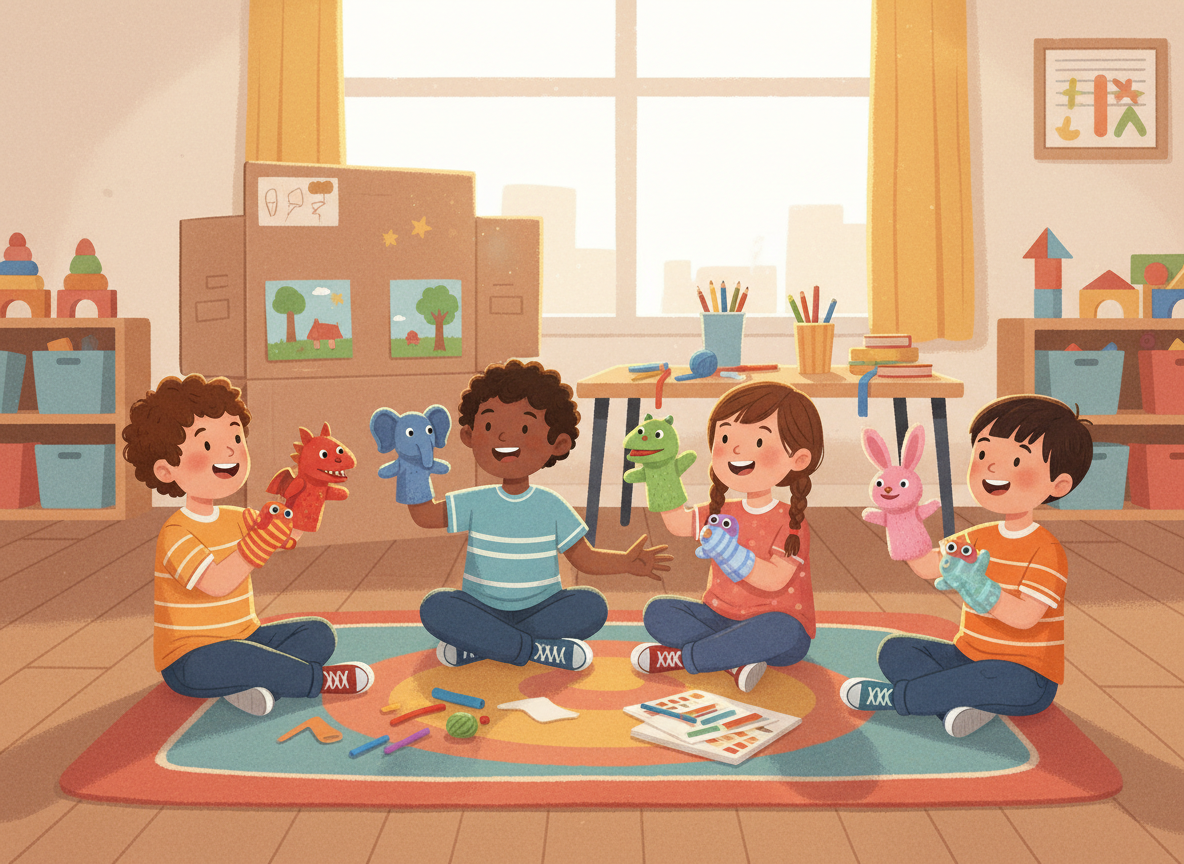
These eight puppet activities for children offer starting points for storytelling, imaginary characters and group drama. Use a hand puppet, a sock puppet or a simple paper character: the story matters more than elaborate materials.
Getting Started with Puppet Drama
Choose one activity for a short session. Introduce your own puppet first: give it a name, a distinctive movement and a small problem for the children to explore. Children can work with a partner, move a puppet while someone else speaks, or watch before joining in.
Materials: puppets or paper characters, paper and colouring materials for puppet-making, and an optional cloth or table for a puppet stage. For younger children, begin with a shared story led by an adult; give older children more freedom to devise scenes.
1. The Unseen Storyteller
Seat a storyteller facing the group, with two or three puppeteers behind them. The storyteller cannot see the puppets and tells a short story while the puppeteers act it out. Begin with a simple prompt: “Three friends found a tiny door in a tree…” Pause regularly so the puppets can respond.
For younger children: an adult narrates one action at a time. Afterwards, ask the puppeteers which moment they would like to change.
2. Make a Puppet Show
In pairs or small groups, choose a place, two characters and a problem. For example, two animals arrive at a picnic, but the food has disappeared. Decide how the story begins, what the characters try and how it ends. Rehearse a short scene, then share it with another group if the children wish.
Prompt: “What does each character want, and how could they help one another?”
3. Emotional Puppets
Invite a puppet to show a feeling through movement, posture or voice. Perhaps it is excited about a journey or worried about meeting someone new. Ask the group what they notice and what might have happened. Accept different interpretations rather than looking for one correct answer.
Adaptation: offer picture cards or let children choose between two possible situations. They can move the puppet without speaking.
4. Me as a Puppet
Make a paper or stick puppet with something in common with its creator. It might share a favourite colour, hobby or way of moving; it does not need to look like the child. Add an imaginary detail, such as wings or the ability to talk to trees.
Invite children to introduce their puppet with one thing that is the same as them and one thing that is different. Sharing personal information is optional: an entirely invented character works too.
5. Freeze and Change
Two puppets begin a simple scene, such as waiting at a bus stop. Call “freeze”, then invite another puppeteer to take over one position. Their first line starts a new situation: “The spaceship is ready!” The other puppet responds and a different story begins.
For younger children: keep the same setting and change just one detail, such as the weather or an object the puppet finds.
6. Puppet Music Video
Choose a familiar song or a short piece of music. In small groups, explore how puppets might move to it: bobbing, turning, pausing or travelling slowly. Arrange a beginning and an ending, then perform the sequence together. Recording is optional; the activity works as a live puppet dance.
Prompt: “How would your puppet move if this music became slower?”
7. Puppet Talk Show
An adult or child hosts a talk show with two or three puppet guests. The guests introduce themselves, then answer questions from the host or audience. Invent characters such as a dragon who dislikes flying, a lost explorer or a baker preparing an enormous cake.
Questions to try: “What happened to you today?”, “What do you need help with?” and “What would you like to do next?” A partner can answer on a puppet’s behalf.
8. What If?
Choose two or three puppets and offer a problem: “What if two friends both wanted the same toy?” or “What if a dragon arrived at the school gate?” Act out one possible response, then return to the beginning and try another.
Ask what changed between the versions. Let the children suggest the next problem and decide which roles they want to explore.
More Drama Ideas for Your Group
For shorter activities, try these drama games for preschoolers aged 3–5. Explore the inquiry-led drama collection for more ways to build a story around children’s ideas.
Find more ready-to-use activities in Drama Start on Amazon.

Helpful!