
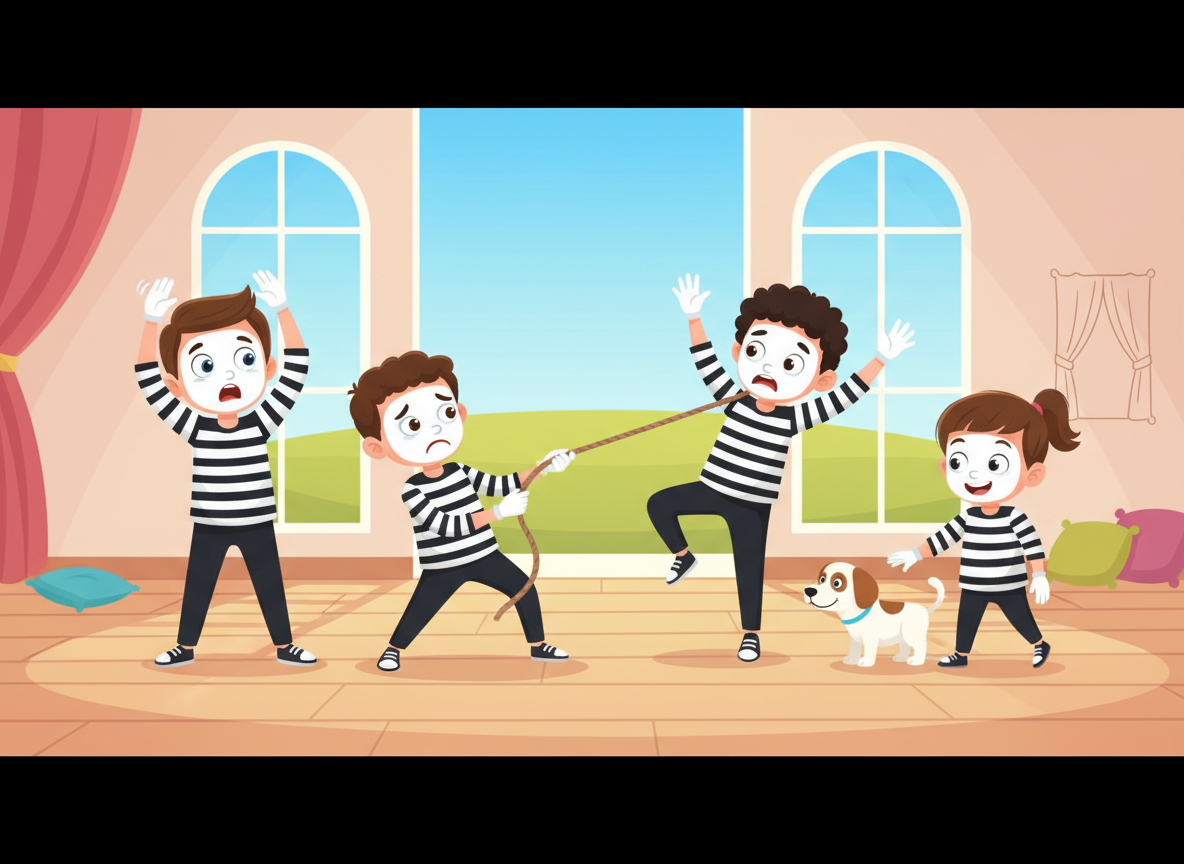
Explore mime ideas for kids in the Drama Start Mime Hub — a collection of free mime games, solo performance prompts and teaching activities for children. Whether you need a five-minute warm-up, a complete mime workshop or a short solo mime for a class, start here and choose the activity that suits your group.
Mime Ideas for Kids: Games and Activities
New to mime? Begin with Mime Ideas for Kids: Games, Activities and a Complete Mime Workshop. It includes warm-ups, imaginary-object games, movement prompts, emotion work and group mime activities. It is a useful starting point for teachers, drama leaders and parents.
One-Minute Mime Ideas
Need something very quick? Try the One-Minute Solo Mime Ideas for Children. These short, no-prop prompts are ideal for warm-ups, individual challenges, drama classes and confidence-building.
Two-Minute Mime Ideas
For a slightly longer performance challenge, use the Two-Minute Solo Mime Ideas for Children. The extra time allows children to develop a beginning, middle and end and tell a clearer story without words.
Solo Mime Ideas
Explore longer individual scenarios in Solo Mime Ideas for Children. Solo work encourages concentration, imagination and physical storytelling while giving each child the opportunity to create a complete character or situation.
Occupational Mime
Occupational Mime Ideas for Children focuses on showing jobs and everyday actions clearly through movement. It is particularly useful for introducing the importance of imaginary objects, size, weight, shape and consistent physical action.
Mime Plays
Mime can also be combined with narration. Cú Chulainn: Mime Play for Children uses a storyteller while performers communicate the action physically — a useful bridge between mime, storytelling and scripted drama.
What Does Mime Develop?
- Imagination and creative thinking
- Body awareness and physical control
- Facial expression and gesture
- Observation and concentration
- Non-verbal communication
- Confidence and performance skills
- Understanding of character, emotion and story
A Simple Mime Lesson Structure
Start with a physical warm-up, move into imaginary-object work, introduce a short mime prompt and finish with individual or small-group performances. Ask the audience what they understood from the movement rather than simply whether they could “guess” the mime. This encourages children to think about how clearly they communicate through the body.
Featured Book: Movement Start
For more movement and imaginative drama activities to complement these mime ideas, explore Movement Start. Buy Movement Start on Amazon.

Comments (6)