
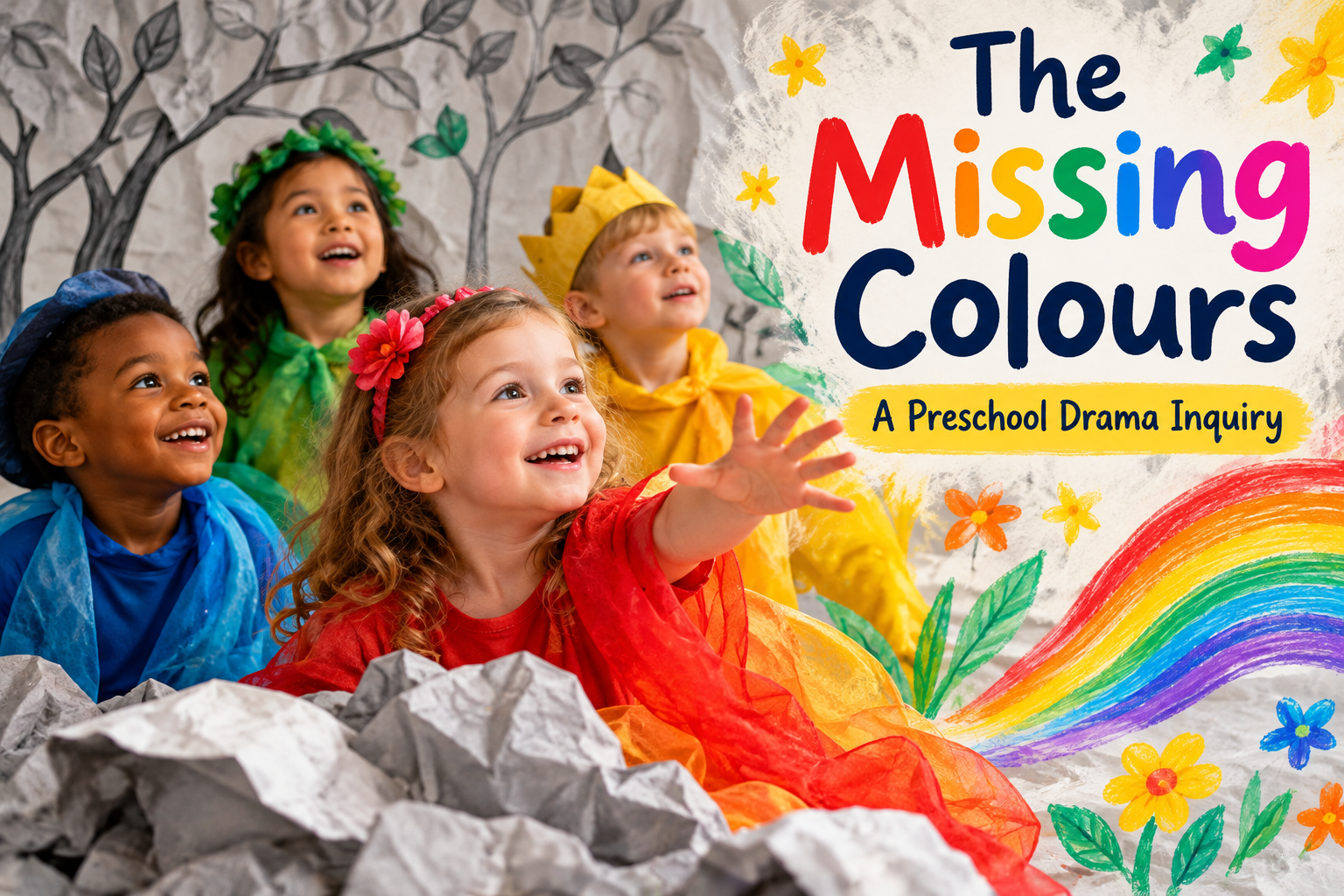
One morning, the children discover something strange: the colours have disappeared from an imaginary world. The flowers are pale, the birds have forgotten their bright feathers and even the rainbow is missing. Where have the colours gone? In The Missing Colours, children investigate this mystery through movement, role play, storytelling and imaginative play. The children decide what happened and how their story develops; there is no script to memorise and no predetermined solution.
Age group: approximately 3–6 years. Duration: 30–45 minutes, or shorter experiences across several days. Resources: open floor space; optional coloured scarves, fabric scraps, paper or loose parts. The workshop also works without props. Focus: observation, questioning, creative movement, communication, cooperation and child-led inquiry.
Starting Point: Something Has Changed
Invite the children to imagine a familiar garden, town or forest. What is usually there? What does it look and sound like? Then share a message from an imaginary visitor: “I woke up today and all the colours had disappeared. Can you help me find out what happened?” If helpful, show a plain piece of fabric beside a colourful one, but allow the mystery to live in the children’s imaginations.
Open-ended questions: What do you notice? Which colours might be missing? How would the world feel without them? Who might know what happened? What should we investigate first? Record the children’s suggestions rather than choosing an answer.
1. Explore the Colourless World
Invite the children to walk through the imaginary world. They might move through a garden, a playground, a market or a woodland. What has changed? Children can become trees, butterflies, flowers or shopkeepers and show how their world feels. Encourage different interpretations: a colourless world might seem quiet, surprising, funny or mysterious.
Drama invitation: “Show me a place that has lost its colour. What is happening there?” Children can create still images individually or in small groups. Ask what they want the other explorers to notice.
2. Follow the Colour Clues
A tiny spot of colour appears on an imaginary stone. Where could it have come from? Invite the children to become detectives and search for clues. They may invent coloured footprints, a whispering leaf, a trail of paint or a creature carrying a bright feather. Follow their ideas through different imaginary spaces.
Questions: What might this clue tell us? How could we test our idea? What other explanations are possible? If the children decide the colours were never stolen, follow that possibility too.
3. Meet the Keeper of Colours
The children might suggest meeting someone who knows about the missing colours. An educator can briefly take on a role, perhaps as a worried gardener, a travelling artist or a cloud who has never seen a rainbow. The character should ask for help rather than supply the answer.
Possible teacher-in-role prompt: “I have looked everywhere, but I cannot remember where the colours belong. What have you discovered?” Encourage the children to question the character and decide what to do next.
4. Become the Colours
Invite each child to choose an imaginary colour and explore how it might move. Red could stomp, glide or tiptoe; blue might bounce or swirl. There is no single correct movement for any colour. Children can change their minds, combine colours or invent entirely new ones.
Extend the play: What sound would your colour make? How does it travel? What happens when two colours meet? Create a group soundscape or moving picture from the children’s ideas.
5. Create a Colour-Making Machine
Suppose the children decide the world needs new colours. How might they make them? In small groups, invite children to invent an imaginary machine using their bodies, sounds and movements. One child may turn a wheel, another mix colours and another make a magical sound. Alternatively, the children may decide that colours return through dancing, growing, sharing or a completely different process.
Questions: How does your invention work? What happens if it stops? Can everyone contribute in a way that suits them?
6. Decide What Happens Next
Return to the imaginary world. Invite the children to show what has changed, if anything. Perhaps the colours return one at a time. Perhaps the world gains colours nobody has seen before. Perhaps the mystery remains and the children want to continue investigating tomorrow. Let their decisions shape the ending.
Following the Children’s Inquiry
The educator’s role is to notice, question and extend rather than direct every step. The inquiry may lead towards mixing colours, habitats, feelings, weather, light and shadow, or questions about who gets to decide what a place looks like. Observe which ideas the children return to and offer time and materials to investigate them.
Notice → Question → Investigate → Discover
Notice: What changes or details attract the children’s attention? Question: What do they wonder about the missing colours? Investigate: How do they test ideas through role, movement, talk and play? Discover: What new stories, theories or questions emerge? The cycle can begin again at any point.
Adapting for Different Ages and Needs
Ages 3–4: Focus on a single provocation and two short invitations, such as exploring the colourless world and becoming colours. Use simple repeated language and plenty of time for movement. Ages 5–6: Invite children to take on roles, interview a character, build competing theories and revisit the mystery over several sessions. For children who prefer not to speak or perform, offer observation, drawing, object play, gesture or sound-making as equally valued ways to participate.
Reflection and Possible Extensions
Ask: What did we discover? Did everyone imagine the same thing? What changed our minds? What should we investigate next? Children might draw a map of their imaginary world, create a colour museum, mix paints, build a landscape with loose parts or tell the story from another character’s point of view. These are possibilities, not tasks every child must complete.
Featured Book: Drama Start: Inquiry and Play

If you enjoyed this open-ended drama inquiry, Drama Start: Inquiry and Play by Julie Meighan offers further practical starting points for exploring an emergent curriculum through children’s questions, imagination and play.
More Inquiry-Led Drama Ideas
Explore Inquiry-Led Drama for Young Children, Mysterious Footprints and The Three Little Pigs: A Child-Led Drama Inquiry for more practical inspiration.
