
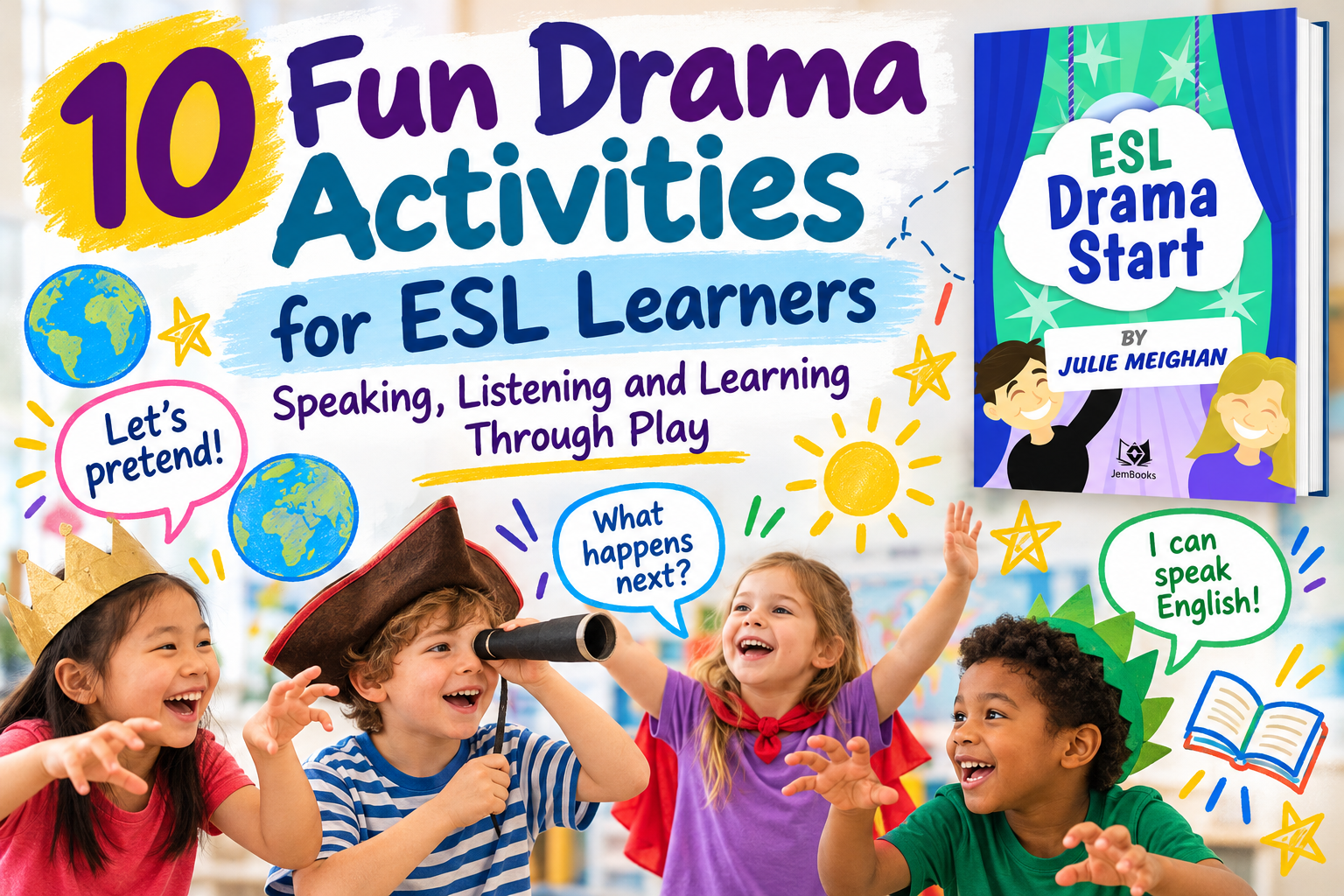
ESL drama activities offer a playful way for children learning English as a second or additional language (ESL/EAL) to develop speaking, listening and confidence. Children can join in through gesture, movement and imaginative play, even when they are not yet ready to speak in full sentences.
How to use these activities: Begin with an imaginary situation, model a few useful words, and follow the children’s ideas. There is no need for a stage, memorised lines or a finished performance.
1. The Magic Bag
Language focus: Objects, adjectives and questions.
Pretend to reach into an invisible bag. Lift out something mysterious: a tiny mouse, a heavy suitcase or a huge balloon. Show its size and weight without naming it. Invite children to guess, then take turns discovering their own imaginary objects.
Try asking: What could it be? Is it big or small? What can it do?
2. Walk Like an Animal
Language focus: Animals and action verbs.
Turn the room into an imaginary animal park. Invite children to stomp like elephants, slither like snakes and hop like rabbits. Let them invent animals and show how each one moves.
Try asking: Which animal moves slowly? Can it jump? Where does it live?
3. The Magic Door
Language focus: Places and descriptive language.
Imagine a mysterious door in the room. Explore its shape and size, then open it together. Perhaps it leads to a jungle, a castle or an underwater world. Follow the children’s discoveries.
Try asking: Where are we? What can you see or hear? Who lives here?
4. What’s the Weather?
Language focus: Weather vocabulary and feelings.
Begin on a warm sunny day. Gradually bring in wind, rain, snow or thunder. Children show the changing weather through their bodies and decide what happens next.
Try asking: Is it raining? Are you cold? What should we do?
5. At the Market
Language focus: Greetings and everyday conversation.
Create an imaginary market. Children choose stalls and take turns as customers and stallholders. Model short exchanges without insisting on memorised scripts.
Try asking: Hello! Can I have an apple, please? Here you are. Thank you.
6. Emotion Statues
Language focus: Feeling words and expression.
Invite children to move around the space and freeze as a happy, worried, surprised or excited statue. Ask what might have happened to their imaginary character.
Try asking: How do you feel? Why? What could help?
7. The Lost Teddy
Language focus: Questions and positional words.
An imaginary teddy has gone missing. Become detectives and search under, behind, beside and inside imaginary objects. Let children decide where Teddy has been.
Try asking: Where is Teddy? Is Teddy behind the door?
8. Pass the Invisible Object
Language focus: Describing and action verbs.
Pass an imaginary object around the circle. Each child communicates its weight, shape and use through movement. The object may transform from a feather into a giant stone.
Try asking: What are you holding? Is it heavy? What can you do with it?
9. The Enormous Turnip
Language focus: Repetition and story sequencing.
Imagine planting a tiny seed and watching it grow. Act out pulling an enormous turnip together, inviting new characters to help. Children choose who arrives next.
Try asking: Pull, pull, pull! Help me, please! Who comes next?
10. A Journey Through the Jungle
Language focus: Listening and collaborative storytelling.
Set off through an imaginary jungle. Cross a river, climb over a fallen tree and listen for animals. Pause to let children decide where the journey goes.
Try asking: What can you hear? How will we cross? What happens next?
Using ESL Drama Activities to Help English Language Learners Join In
Welcome gestures, facial expressions, home languages, single words and longer sentences. Repeat useful phrases naturally, allow thinking time and avoid interrupting imaginative play to correct every error. Offer sentence starters to developing speakers and invite more confident children to extend the story.
Featured Book: ESL Drama Start

ESL Drama Start by Julie Meighan offers further ideas for supporting English language learning through imaginative drama.
More Free ESL Drama Activities and Resources
Explore the ESL Drama resources hub, ESL drama icebreakers, and storytelling activities for ESL classes.
