
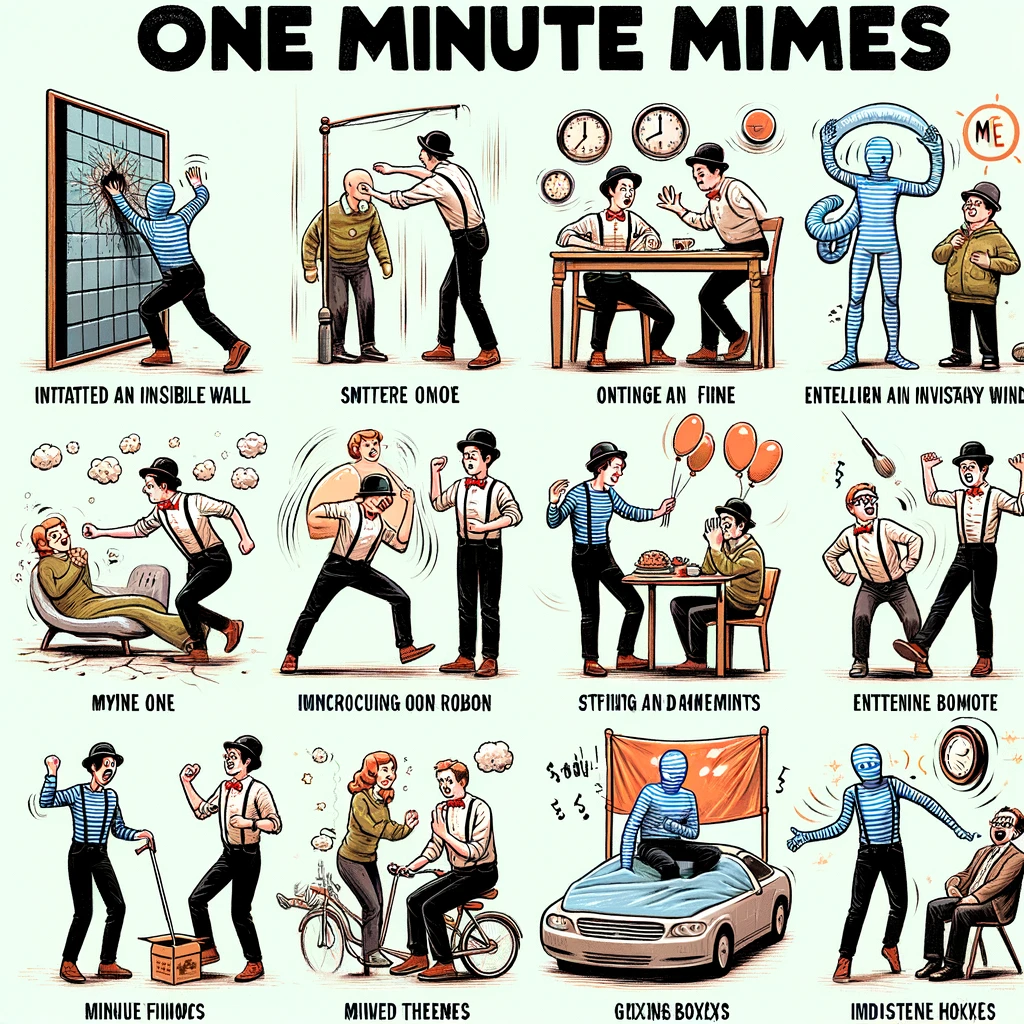
These one-minute solo mime ideas for children are quick, no-prop drama prompts that help children practise physical expression, imagination, focus and storytelling without words.
For a longer challenge, try these two-minute solo mime ideas.
10 One-Minute Mime Ideas
1. The Invisible Wall (1 minute)
-
- Step 1: Stand in place and act as if you’ve encountered an invisible wall.
- Step 2: Touch the wall with your hands, showing surprise.
- Step 3: Push against the wall with your palms.
- Step 4: Lean against the wall and try to peek over it.
- Step 5: Show frustration as if you can’t get past it.
- Walking Against the Wind (1 minute)
- Step 1: Start walking in place.
- Step 2: Gradually slow down and act like you’re pushing against a strong wind.
- Step 3: Lean forward, struggling to make progress.
- Step 4: Take small, exaggerated steps to depict the effort.
- Step 5: Finally, stop and show relief as the wind subsides.
- Eating an Imaginary Meal (1 minute)
- Step 1: Set an imaginary table with plates, utensils, and food.
- Step 2: Sit down and enthusiastically mime eating, using exaggerated facial expressions.
- Step 3: Act as if you spill something and clean it up.
- Step 4: Finish the meal and show satisfaction.
- Step 5: Clear the table and leave with a contented look.
- Fishing (1 minute)
- Step 1: Cast an imaginary fishing rod into an imaginary body of water.
- Step 2: Wait patiently with anticipation.
- Step 3: Suddenly feel a big catch on the line.
- Step 4: Reel it in with enthusiasm.
- Step 5: Show off your “big fish” with pride.
- Ballooning (1 minute)
- Step 1: Inflate an imaginary balloon, holding it above your head.
- Step 2: Tie the balloon’s string with care.
- Step 3: Release the balloon and watch it float away.
- Step 4: Wave goodbye to the balloon.
- Step 5: Pretend to see it disappear in the distance.
- Mime a Robot (1 minute)
- Step 1: Begin with stiff, mechanical movements.
- Step 2: Move your arms and legs in a robotic, jerky fashion.
- Step 3: Make robotic sounds with your mouth, like beeps and whirs.
- Step 4: Slowly start to “malfunction” with funny, exaggerated glitches.
- Step 5: Freeze in a final pose, as if you’ve powered down.
- Boxing (1 minute)
- Step 1: Assume a boxing stance with your fists up.
- Step 2: Shadowbox, throwing punches and dodging.
- Step 3: React to imaginary hits with exaggerated movements.
- Step 4: Finish with a knockout punch and a triumphant pose.
- Step 5: Take a bow as if you’ve won the match.
- Walking on a Tightrope (1 minute)
- Step 1: Mime setting up an imaginary tightrope in front of you.
- Step 2: Step onto the tightrope and balance carefully.
- Step 3: Take slow, exaggerated steps to maintain balance.
- Step 4: Act as if you almost fall but regain balance.
- Step 5: Successfully reach the end and celebrate.
- Trapped in a Box (1 minute)
- Step 1: Mime the creation of a small, invisible box around you.
- Step 2: Act like you’re trying to push the walls apart.
- Step 3: Show frustration and desperation.
- Step 4: Find a way to escape, pushing the “walls” open.
- Step 5: Step out of the box and breathe a sigh of relief.
- Becoming a Statue (1 minute)
- Step 1: Strike a dramatic pose and freeze completely.
- Step 2: Hold the pose for several seconds.
- Step 3: Slowly “unfreeze” and come to life with fluid movements.
- Step 4: Move gracefully and expressively.
- Step 5: Conclude by striking another pose and freezing again.
More Mime and Movement Activities
Explore more solo mime activities and movement and drama games for children.
Want a longer challenge? Try the two-minute solo mimes or explore Movement and Drama Games for Children.
Free Book + Free Subscriber Drama Resources
Enjoyed this resource? Join Drama Start and receive a FREE copy of Aesop’s Fables on Stage. Subscribers also receive free subscriber drama resources, including plays, games, workshops, movement ideas and practical activities selected for the mailing list.
Featured Books: Movement and Drama Activities
Movement Start

Over 100 movement activities and stories for children, encouraging creativity, physical expression and imagination.
Drama Start Two

Drama activities and plays for children aged 9–12, with opportunities to explore character, expression and performance.

Comments (5)