
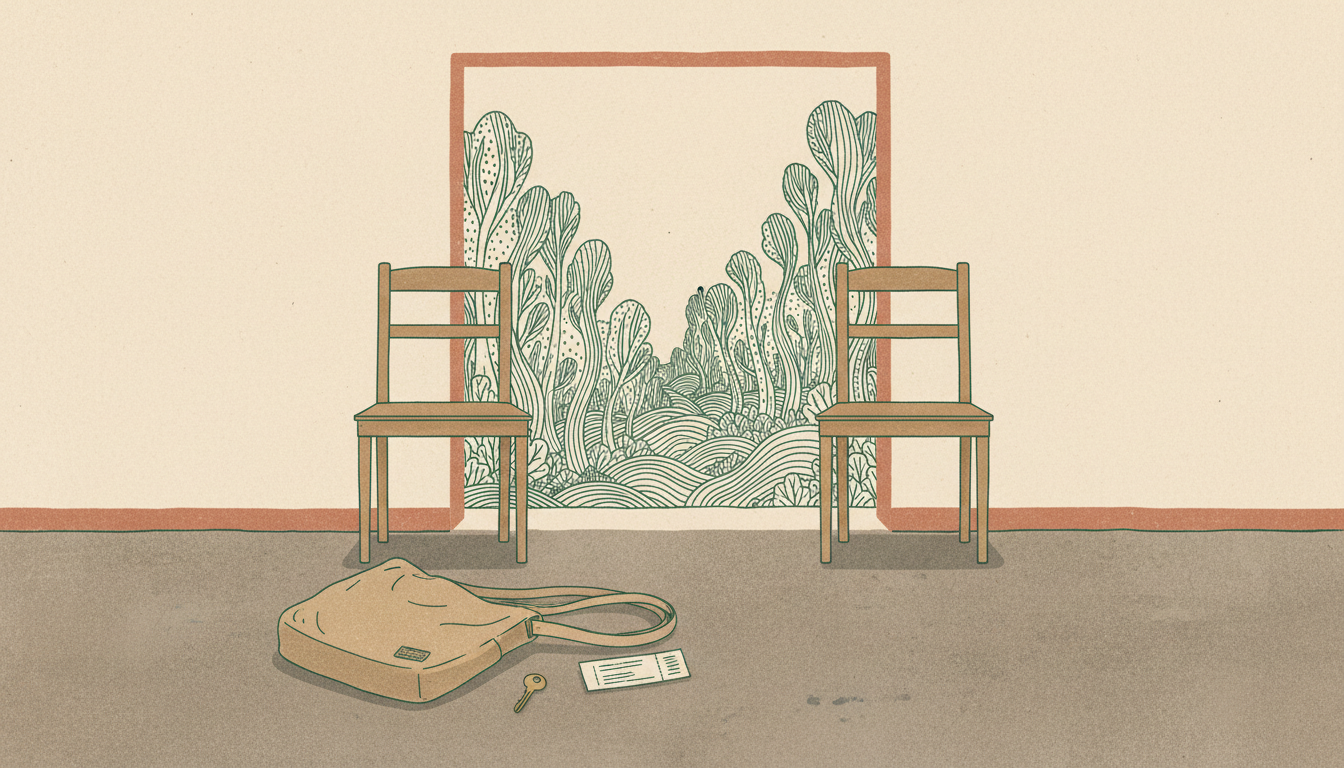
Why would someone keep a key that no longer opens their door? Place a bag in the middle of the room and imagine finding that key inside. One participant might see a keepsake. Another might wonder whether its owner still hopes to go back. Both ideas give the group somewhere to begin.
In my workshop Homelessness, Needs and Poverty, participants build a fictional character and explore a day in that person’s life. Here is a shorter version for secondary classrooms, youth groups and social care students. You’ll need a bag, paper, pens and two chairs.
Tell the group from the outset that the story is invented. Nobody needs to share where they live or describe anything that has happened to their family. Participants can suggest ideas, observe, narrate or pass.
The bag: what can three objects tell us?
Explain that the owner of the bag is staying somewhere temporary. Invite the group to imagine its contents and choose three objects. A key, a bus ticket and a child’s drawing would each raise a different question. Who drew the picture? Where does the owner need to get to today? Let the group settle on a few details and leave some questions open.
Draw the outline of a person on paper. Around the outside, write what a stranger might assume about the owner. Inside, write what the group has decided the character wants, misses or needs. If someone says the character is lonely, ask, “Has anything in our story told us that yet?” Give the group room to change its mind.
The door: who gets to make the decision?
Set two chairs apart to mark a doorway. In pairs or small groups, make a short scene in which the character asks for something they need. They might be a young person asking a relative for somewhere to stay, or a parent asking a support worker where the family can sleep that night. Decide who is on either side of the doorway and what each person has the power to do.
Play the scene once. Then replay it and invite an observer to call “Freeze” and take over a role to try a different response. Suppose the worker’s first answer is “Come back tomorrow.” What changes if they ask whether the parent can get back tomorrow, then offer to make a call while the parent is there? Play long enough to hear the parent’s answer.
Afterwards, ask two questions separately. “What became easier for the character?” and “What do they still need when they leave?” Someone may have listened carefully and made a useful call while the family still needs somewhere to sleep. That distinction gives the group a way to talk about both dignity and access to housing.
Coming out of role
Ask everyone to step away from the chairs and say their own name. Return to the bag and invite one final observation: “Which assumption did we revise, and what in the scene made us revise it?” Participants can answer about the fictional character without drawing on personal experience.
Featured book: Drama for Social Issues

The full workshop begins on page 83 and includes an opinion line, still images, hot seating and writing in role. Find Drama for Social Issues: Practical Workshops for Social Care, Youth Work and Education on Amazon.
