
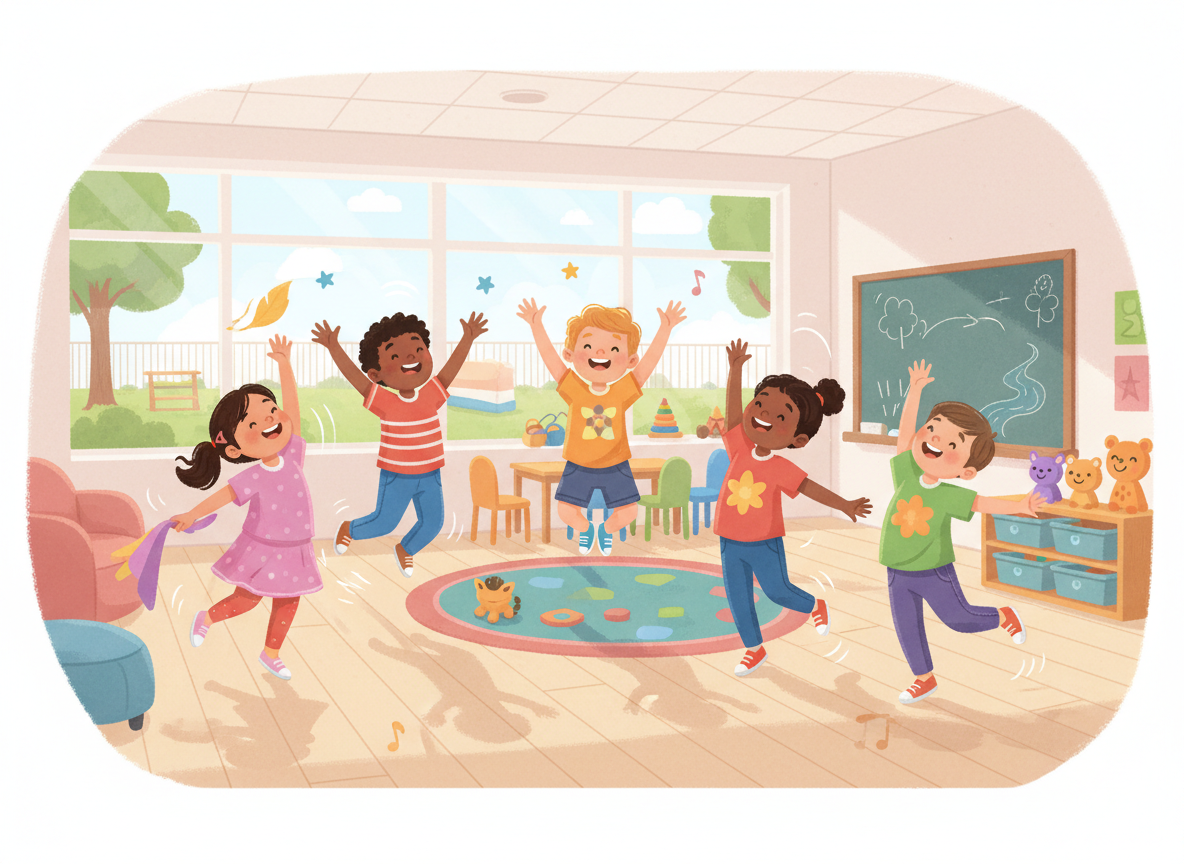
Action poems for young children bring words, rhythm and movement together. A bowl becomes enormous, a forest grows around us and a familiar fairy tale becomes something we can explore with our whole bodies.
These Goldilocks and Sleeping Beauty activities are starting points for preschool and early years drama, especially with children aged 3–6. Begin with a familiar rhyme or story, then make space for children to invent movements, ask questions and decide what might happen next.
You will need: A clear space and your imagination. Bowls, chairs, forests and towers can all be mimed. Allow children to join through seated movement, gesture, sound, speech or observation.
How to use action poems in early years drama
Say or sing a short section and invite children to respond. Try it slowly, then pause to notice their ideas. You can model one possibility without expecting everyone to copy. Repeat sections children enjoy and let them suggest changes.
“How could we show that? Does anyone have another idea?”
An action rhyme is a movement activity in its own right. It can also open into process drama when the group enters a shared imaginary situation and explores roles, problems and choices.
1. Goldilocks: big, small and just right
Use the familiar opening from the original activity: “When Goldilocks went to the house of the bears…” Invite children to walk towards an imaginary house. Pause at the door.
“What do you notice about this house? How could we find out who lives here?”
Explore the objects in the story one at a time. You can speak the following simple prompts rhythmically and repeat them with the children.
Three bowls: “A huge bowl, a small bowl, a tiny bowl too. One, two, three. What could we do?”
Invite children to make different bowl shapes with their arms or hands. “How would you carry each one? What might be inside?”
Three chairs: “A huge chair, a small chair, a tiny chair too. One, two, three. Which would suit you?”
Children can stretch, curl or mime sitting. “How could we tell whether a chair would hold us?”
Three beds: “A huge bed, a small bed, a tiny bed too. One, two, three. Who sleeps where, do you?”
Invite children to make bed shapes or mime settling down. “What could make a bed comfortable?”
Three bears: Explore how each bear might walk, stretch, yawn or greet someone. Size does not have to determine personality or voice. “What is your bear like? How will we know?”
Turn Goldilocks into a drama inquiry
Enter as a bear arriving home. “Something has changed in our house. Can you help me work out what happened?” Let children become bears, neighbours or investigators. Their observations can become clues in the shared story.
“What do you notice? What makes you think that? Who could we ask? What should we do next?”
Perhaps Goldilocks is lost, hungry or looking for someone. Invite children to consider her perspective as well as the bears’ feelings. They might welcome her, explain what upset them or help her find her way home. Let the group shape the response.
2. Sleeping Beauty: a forest full of possibilities
The original post used “There was a princess long ago” as a circle activity. Use the story as a movement sequence, with roles children can choose and share. Any child can take any role.
The tower: Children use hands, arms or their whole bodies to make towers of different shapes. “How tall is our tower? Where is the entrance? Who lives here?”
The spell: Invite children to invent a gesture or sound for an imaginary spell. “What happens when this spell is cast?” They might become still, move slowly or float like feathers.
The sleeping castle: Children mime resting in a comfortable position. Some can remain awake as guardians or visitors. “What sounds might we hear in a very quiet castle?”
The growing forest: Begin as a tiny seed, then stretch, reach and sway. Seated children can grow branches with their hands and arms. “How could we show a forest growing over many years?”
The visitors: A group arrives at the edge of the forest. Invite them to choose how they travel and what they carry. “How could we reach the castle without damaging the trees?”
The awakening: Ask children what might break the spell. A song, a message, a gentle breeze or an act of kindness could change the story. Mime the chosen idea and explore what happens.
The celebration: Let the group invent a welcome for everyone in the castle. They might create a soundscape, a dance or an imaginary feast.
Follow the children’s questions
A child might wonder why the forest grew, whether the fairy can undo the spell or how the sleeping people will feel when they wake. Choose a question that interests the group and explore it in role.
You can move between Notice → Question → Investigate → Discover. Notice something in the fiction, wonder about it, try an idea and reflect on what changed. Return to the movement rhyme whenever the group needs a familiar shared rhythm.
Make room for different ways of joining in
Offer a few roles or actions at a time. Children can watch before joining, make a sound, use a communication aid or suggest an idea for someone else to try. Leave space between moving children and agree a simple pause signal. Keep the imagined danger gentle and responsive to the group.
For younger children, explore one object or one moment. Older children can negotiate roles, create new verses and explore the same event from different perspectives.
Reflect together
“Which movement did you invent? What surprised you? How did your idea change our story? What would you like to explore next?”
Children can respond through words, drawings or movement. Their questions can become starting points for another drama session.
More drama and movement ideas
Explore more action poems for young children and movement, voice and role in process drama.
For more practical starting points, see Julie Meighan’s Drama Start: Inquiry and Play — Buy on Amazon.
