
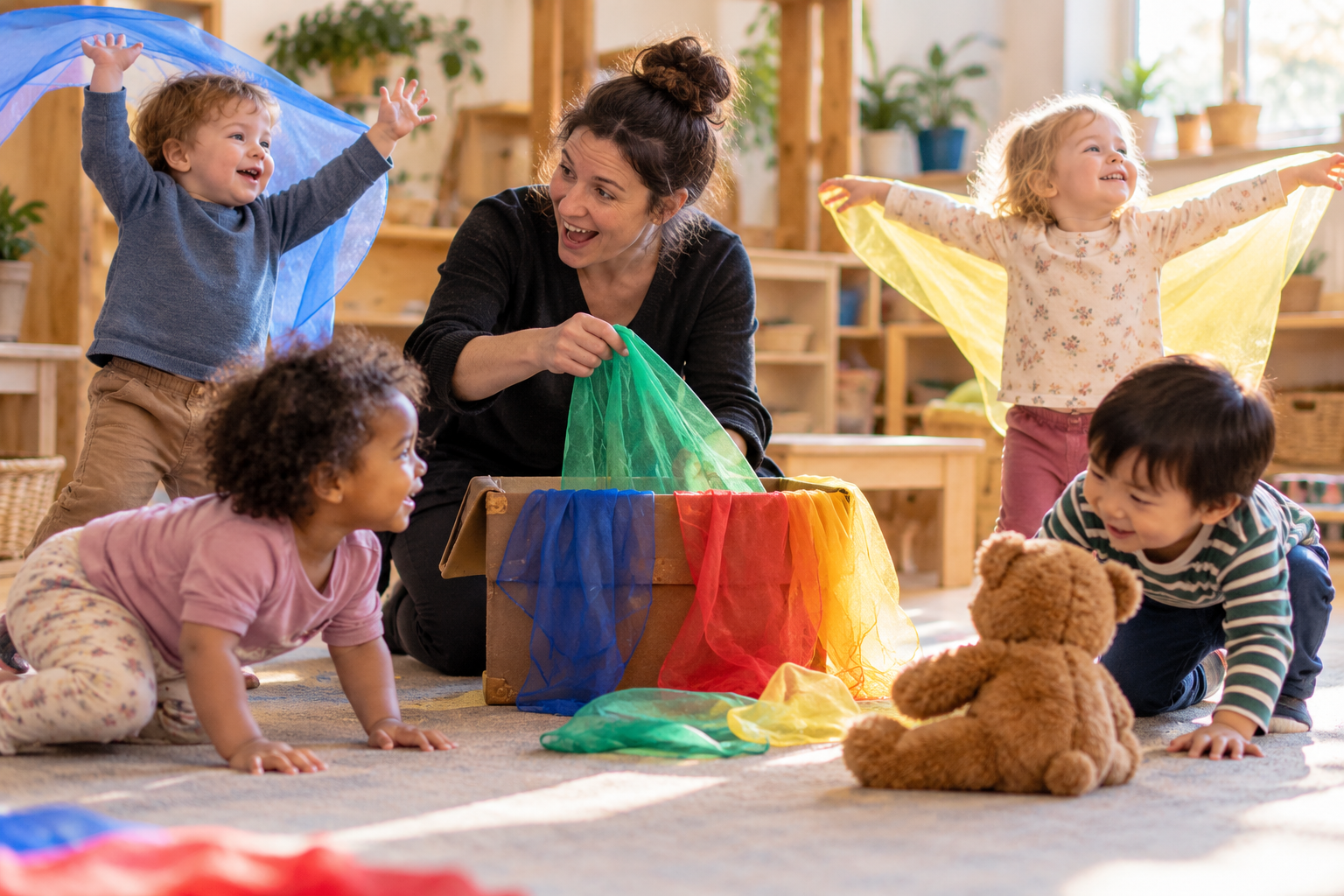
Drama with two-year-olds is about playing together rather than performing. Children do not need to remember a sequence, take on a complicated role or produce a finished story. The educator offers a simple starting point and watches to see what captures the children’s interest.
Some children may join immediately. Others may watch, copy one movement or contribute a sound. All of these are valid ways of participating.
What’s in the Bag?
Bring an imaginary bag into the space. Pretend that it is very heavy. Put it down carefully and look inside.
Ask: “What could be in here?”
Accept whatever the children suggest. If someone says a dog, carefully lift out an imaginary dog. “Oh! He’s wriggling. Can you see him?” The dog might run away. The children might follow it. Someone might decide there is something completely different in the bag. Follow their ideas rather than trying to finish your own story.
We’re Going for a Walk
Invite the children to go on an imaginary walk. Ask, “Where shall we go?” Begin walking together. Something changes. “Oh! The ground feels funny here.”
Perhaps it is sticky, wet, hot, soft or very bumpy. Ask, “How can we walk across it?” Children might jump, crawl, tiptoe or invent their own way of travelling. If a child announces that there is a dinosaur ahead, there is now a dinosaur ahead. Follow that idea.
The Tiny Seed
Curl up very small. “We’re tiny seeds under the ground.” The rain begins to fall. Use fingers to make gentle rain sounds. The sun comes out and the seeds slowly begin to grow.
Children stretch, twist and reach upwards. Ask, “What are you growing into?” Don’t require everyone to become a flower. One child might become a huge tree, another a strawberry and another something entirely imaginary.
The Lost Teddy
Introduce a teddy or soft toy. Teddy has a problem. “Teddy can’t find his blanket.” Pause. “Where could we look?”
Follow the children’s suggestions. Look under imaginary beds, inside cupboards, behind trees or wherever they suggest. You don’t have to find the blanket quickly. The searching is the drama.
Animal Wake-Up
Everyone curls up and pretends to be asleep. Very quietly say, “I wonder who’s sleeping here?” One child might say a cat. Slowly wake up as cats. Stretch, crawl and make sounds.
Then ask, “Who else might be sleeping?” Let the children’s suggestions determine what comes next. There is no correct way to portray the animal.
The Big Puddle
Stop suddenly. “Oh! Look at this enormous puddle.” Look down at an imaginary puddle. Ask, “How are we going to get across?”
The children might jump over it, walk through it, swim across it or build an imaginary bridge. Then something else can emerge naturally. “What’s that in the puddle?” Again, use whatever the children offer.
The Wind Is Blowing
Begin with a gentle breeze. Move your hands and body slowly. “The wind is blowing.” Invite the children to show you what happens to their bodies.
Gradually change the wind. It might become strong, disappear completely or blow everyone sideways. Ask, “What else is blowing in the wind?” Children might become leaves, trees, birds, umbrellas or something unexpected. This can develop into a lovely movement and sound drama without needing a story at all.
Where Is the Little Bird?
Notice something imaginary. “Did you hear that?” Listen. Make a quiet bird sound. “I think there’s a little bird somewhere.”
Search together. Ask, “Where could it be?” The children might find it in a tree, under a chair or sitting on someone’s head. Once the bird is found, ask, “I wonder what it wants?” That question can take the drama anywhere.
The Magic Box
Place an imaginary box in the middle of the group. Open it very slowly. React to whatever you can “see”. Ask, “What do you think is inside?”
Take out the children’s imaginary objects one at a time. If someone says there is a ball, throw and catch it. If someone says there is an elephant, suddenly you have a much bigger problem. The important part isn’t guessing what is in your box. The children’s suggestions create the contents.
The Sleeping Dragon
Tell the children, “There’s a dragon asleep over there.” Point to an empty part of the room. Immediately you have created an imaginary world without needing props.
“Shall we go and see?” Move towards it together. “How will we walk so we don’t wake it?” Tiptoe, crawl or follow children’s suggestions. Someone will probably wake the dragon. That’s fine. Ask, “What should we do?” The dragon doesn’t have to be frightening. The children may decide that it is hungry, lonely, wants to play or needs help.
The Educator’s Role
With two-year-olds, keep returning to one principle: offer the starting point, but don’t decide where the drama has to go.
Instead of asking questions where you already know the answer, use genuine questions such as “What do you think?” “What can you see?” “Where shall we go?” “What could we do?” and “What happened?”
You can also notice rather than question: “You’re moving very slowly.” “Your bird has gone very high.” “I can see you’ve found something.” This is particularly useful with two-year-olds because too many questions can turn imaginative play into an adult-led language exercise.
These are not activities that have to reach a predetermined ending. They are simple starting points for shared drama, with the educator observing, joining the play and allowing the children’s ideas to change what happens.
For more ideas for very young children, visit the Preschool Drama Activities hub.
