
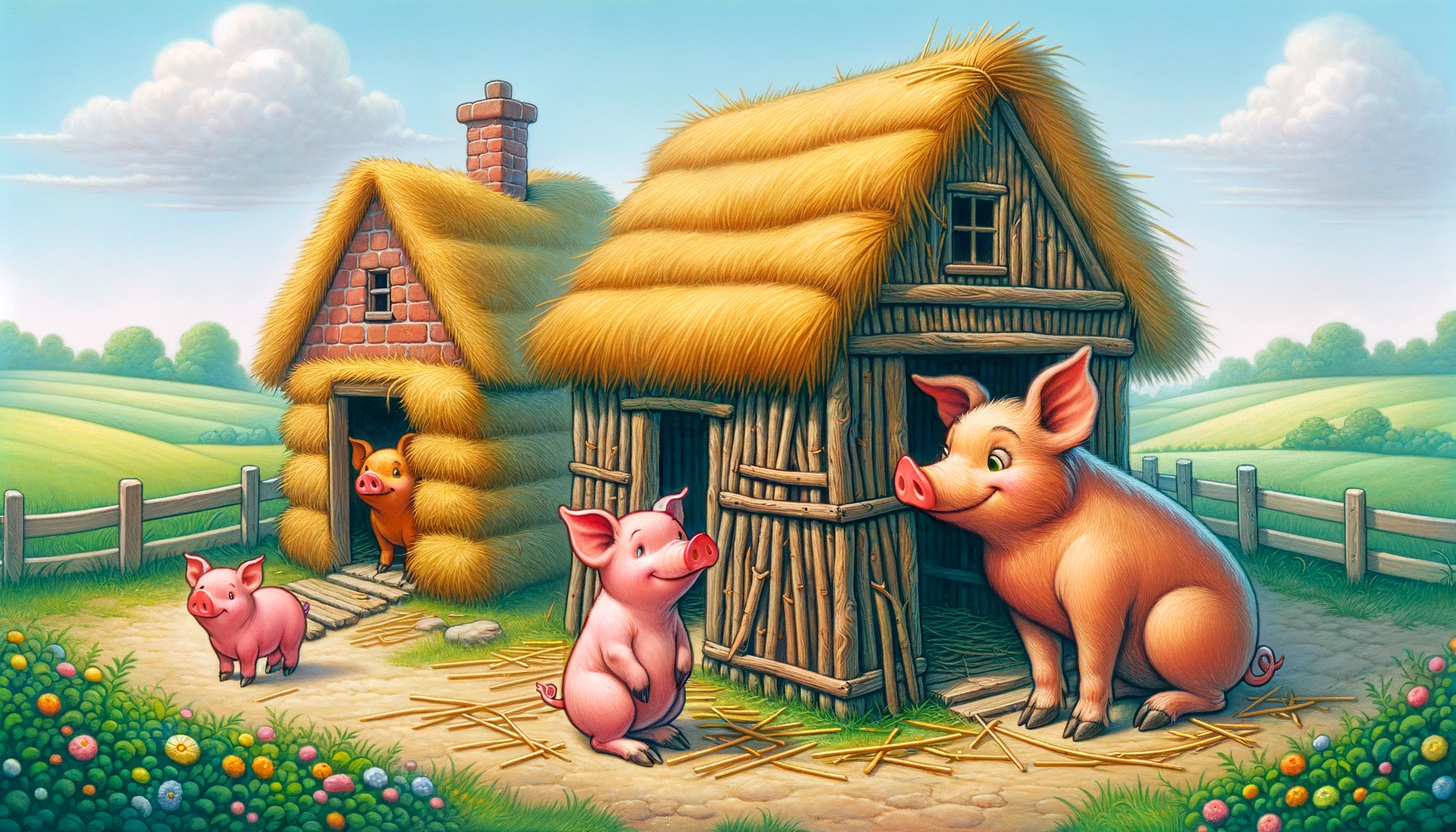
This Three Little Pigs drama inquiry begins with a story most young children already know. There are houses to build, a wolf to meet, problems to solve and plenty of opportunities for movement, mime and role play.
But what happens if, instead of simply acting out the story, we use it as the starting point for an inquiry?
You don’t need straw, sticks, bricks, costumes or props. All you need is an open space and imagination.
The key difference isn’t the resources we use.
It’s the questions we ask.
Starting a Three Little Pigs Drama Inquiry
A traditional drama based on The Three Little Pigs might begin with the educator deciding what will happen.
“Let’s build the first pig’s house. It’s made from straw.”
The children mime collecting straw and building.
The wolf arrives.
The house is blown down.
Next comes the stick house and finally the brick house.
There is nothing wrong with this.
Children are moving, pretending, taking roles and entering an imaginary world. They are exploring character, action, space, tension and belief.
But the educator already knows where the drama is going. A Three Little Pigs drama inquiry offers another way to explore the story.
The children are participating in our version of the story.
So let’s try it differently.
“We Need Somewhere to Live”
Begin with a simple problem:
“We’ve left home and we need somewhere new to live.”
Then stop.
Instead of telling the children what they need, ask:
“What do we need?”
You might hear:
A house.
Somewhere warm.
A bed.
Food.
Somewhere safe.
Follow their ideas.
Then ask:
“What do we need to think about before we build somewhere to live?”
Perhaps it needs a roof.
Maybe it needs windows.
It might need to keep out the rain.
It needs enough room for everyone.
Someone might decide it needs a very strong door.
Already the children are doing more than retelling a story. They are beginning to investigate a problem.
What Should We Build It From?
Now ask:
“What could we build our house from?”
Don’t offer straw, sticks and bricks.
See what happens.
Children might suggest wood, stone, mud, leaves, metal, bricks or something completely imaginary.
Whatever they suggest, explore it.
“Why would that be good?”
“Would it be strong?”
“Would it keep us warm?”
“What would happen if it rained?”
“How could we find out?”
There doesn’t have to be a correct answer.
The children’s ideas become the material for the drama.
Build It Through Mime
Once the group has made some decisions, it’s time to build.
Ask:
“What jobs do we need?”
Children might become builders, architects, carpenters or roofers. Someone might collect materials while somebody else checks whether the building is safe.
Now let them mime the work.
One child might struggle with an enormous imaginary piece of wood.
Another might mix cement.
Someone could climb an imaginary ladder.
Another child might discover that a wall keeps falling down.
You don’t have to demonstrate everything.
Instead, move around the space and ask:
“What are you doing?”
“Why are you putting that there?”
“Do you need any help?”
“How are you going to make that stay up?”
The children’s actions and answers begin to shape the fictional world.
But Is the House Strong Enough?
When the children decide that the house is finished, don’t immediately bring in the wolf.
Ask:
“How could we find out if our house is strong enough?”
Perhaps they want to test the walls.
Maybe they create an imaginary storm.
Someone could make the sound of the wind while others protect the roof.
Perhaps the roof starts leaking.
If a problem develops, resist the temptation to solve it.
Ask:
“What could we do?”
Now the children have another problem to investigate.
Something Happened During the Night
Once the house has been established, you can introduce a little tension.
Tell the children:
“It’s morning.”
Pause.
Look around the imaginary space.
Then ask:
“What do you notice?”
Don’t tell them what has happened.
Let them create it.
Perhaps there are enormous footprints outside.
Maybe the door is open.
Someone might discover that food is missing.
Perhaps part of the wall has been damaged.
A child might suddenly announce:
“I can hear something!”
This is where inquiry becomes exciting because you don’t necessarily know what is going to happen either.
Follow the Children’s Clues
Imagine someone notices footprints.
Instead of saying:
“The wolf has been here!”
ask:
“What do you notice about the footprints?”
Maybe they’re enormous.
Perhaps they’re muddy.
There could be two different sets.
Then ask:
“What do they make you wonder?”
Who made them?
Where did they come from?
Where are they going?
Were they trying to get inside?
Are they still nearby?
And finally:
“How could we find out?”
The children might become trackers, explorers or investigators.
The familiar fairy tale has now become a drama inquiry.
What About the Wolf?
Eventually someone will probably suggest that the footprints belong to the wolf.
That’s fine.
But don’t immediately confirm it.
Ask:
“What makes you think it’s the wolf?”
And:
“How could we find out?”
If the wolf eventually appears, there is another opportunity to keep the inquiry open.
Instead of announcing that this is the Big Bad Wolf, ask:
“What do you notice about the wolf?”
The answers might surprise you.
“He’s angry.”
“He’s hungry.”
“He’s frightened.”
“He’s hurt.”
“He’s lonely.”
Ask:
“What makes you think that?”
Different children may have completely different interpretations of the same character.
That’s worth exploring.
“What Should We Do?”
Now comes one of the most useful questions in inquiry drama:
“What should we do?”
If we were leading the familiar story, we might say:
“Quick! Lock the door!”
But perhaps the children don’t want to.
They might hide.
They might run.
They might talk to the wolf.
Someone might offer him food.
Perhaps they decide that he is lost.
Maybe he needs somewhere to sleep.
The children’s decision determines what happens next.
Step into the Story
The educator can still have a very active role.
You might enter as the wolf.
Perhaps you say:
“Why are you all hiding from me?”
The children may immediately accuse you of trying to blow down their house.
You could respond:
“Blow down your house? Why would I do that?”
Suddenly the children have something new to consider.
You don’t need to give them a long explanation.
Perhaps the wolf simply says:
“I’ve been walking for a long time.”
Or:
“I could smell your food.”
Or:
“I don’t have anywhere to sleep.”
Then let the children decide what happens.
One Solution Can Create Another Problem
Imagine the children decide that the wolf can live with them.
Great.
But the inquiry doesn’t have to end.
Ask:
“Is there enough room?”
Where will he sleep?
Do they trust him?
Does the house need another room?
Should they build him his own house?
What should that house be made from?
A solution has created a new set of questions.
And the inquiry continues.
Notice, Question, Investigate
The process might move through:
Notice → Question → Investigate → Discover → Reflect → Re-question
The children notice footprints.
They wonder who made them.
They investigate through drama.
They develop a theory.
They discover something new.
They reflect on what they originally thought.
And then another question appears.
This isn’t a rigid sequence. Real inquiry moves backwards and forwards as new ideas emerge.
Sometimes One Question Changes Everything
Moving towards inquiry-led drama doesn’t necessarily require a completely different lesson.
Sometimes it means changing one question.
Instead of:
“Let’s build a brick house.”
try:
“What could we build our house from?”
Instead of:
“The wolf is coming!”
try:
“What do you notice?”
Instead of:
“Quick! Lock the door!”
try:
“What should we do?”
Instead of:
“The wolf is dangerous.”
try:
“What do you notice about the wolf?”
The adult is still teaching and facilitating.
We’re simply creating more space for children’s ideas to influence the drama.
Adult-Led Drama Still Matters
Inquiry-led doesn’t automatically mean better.
Sometimes we want to act out the familiar story. Children may love knowing what happens next, joining in with repeated moments and pretending to be the wolf or the pigs.
That can be valuable drama too.
The important thing is recognising the difference.
In an adult-led version, we largely determine the journey.
In an inquiry-led version, we provide a starting point and allow children’s questions, theories and decisions to influence where the drama goes.
Both can have a place in early childhood drama.
Plan the Possibilities, Not the Children’s Responses
Inquiry-led drama still requires planning.
We can plan the starting point.
We can think about possible drama strategies such as mime, role play, movement and teacher-in-role.
We can prepare questions that might deepen the experience.
We can anticipate that houses, materials, building and perhaps even the wolf could become important.
What we don’t need to plan is exactly what the children will say, what they will build, what problem they will encounter, how they will solve it or how their story will end.
The Three Little Pigs gives us the starting point.
Drama allows us to step inside it.
Inquiry allows children to take it somewhere new.
Plan the possibilities, not the children’s responses.
Want more child-led drama starting points? Explore Drama Start: Inquiry and Play on Amazon.
Featured Book: Drama Start: Inquiry and Play

Looking for more practical drama ideas? Explore Drama Start: Inquiry and Play for more activities and inspiration for working with children.

Comments (2)