
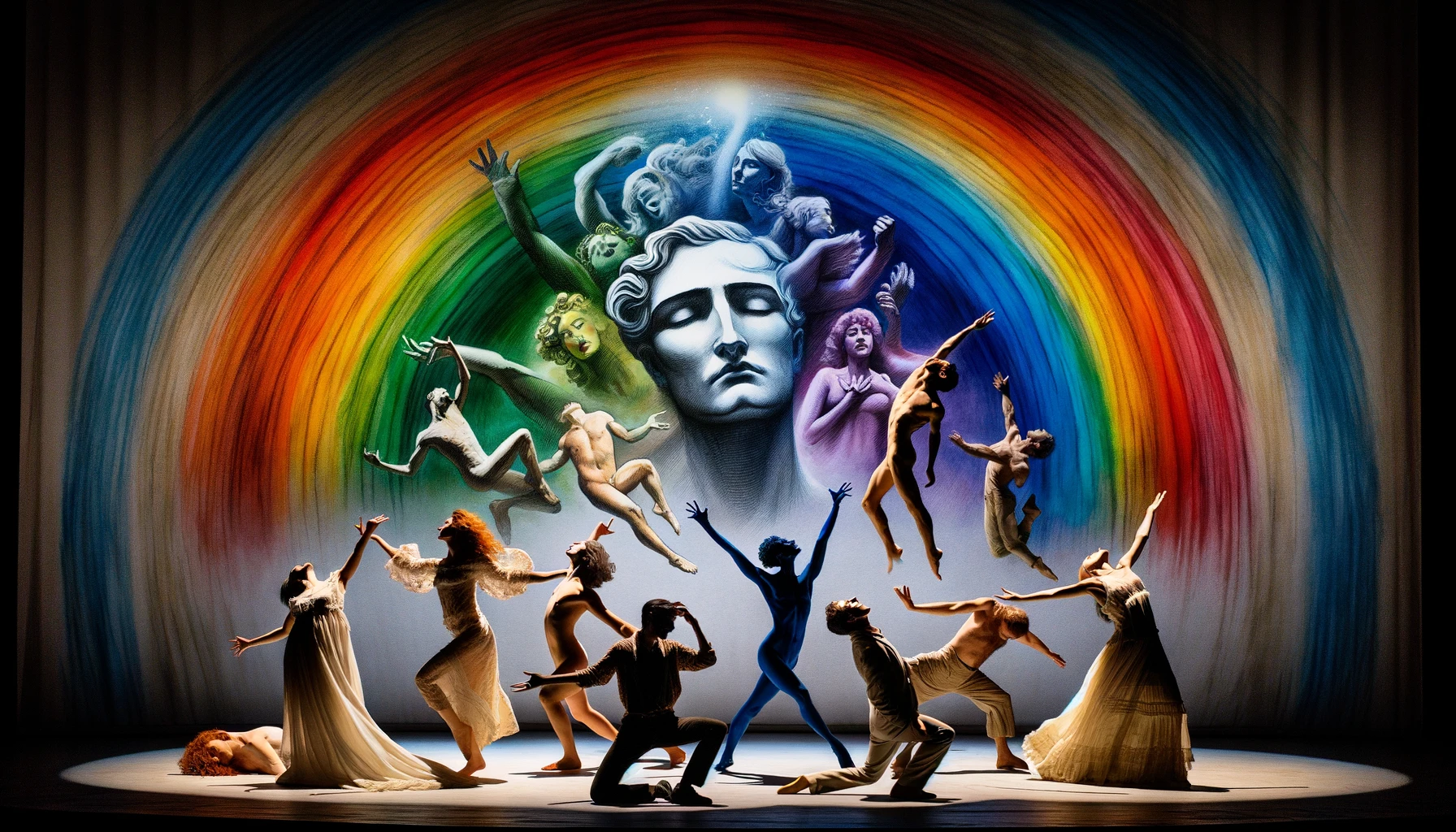
The Rainbow of Desire is a collection of theatre techniques developed by Brazilian theatre practitioner Augusto Boal as part of his Theatre of the Oppressed practice. It uses theatrical images, movement and reflection to make internal feelings, desires and conflicts visible. Rather than being a fixed chart in which particular colours represent particular emotions, the “rainbow” is a metaphor for the different and sometimes conflicting desires within a person.
What Is the Rainbow of Desire?
Boal developed the Rainbow of Desire as a more introspective branch of Theatre of the Oppressed. His work explored how theatre could help participants examine forms of oppression that may have become internalised. The approach is associated with techniques in which thoughts, feelings, fears and desires are represented physically so that participants can see and explore them from different perspectives.
How Does the Rainbow of Desire Work?
A participant may begin with a real or imagined situation involving tension or conflict. Other participants can then create physical images representing different desires, pressures, emotions or perspectives within that situation. By arranging, observing and changing these images, the group can investigate what may be happening beneath the surface of the scene.
The emphasis is not on producing a polished performance. The theatre becomes a way of making an experience visible and allowing different possibilities to be examined.
Is It Literally Seven Colours and Seven Emotions?
No. The title can easily lead to this misunderstanding. Boal’s Rainbow of Desire is not simply a system assigning fixed emotions such as sadness or happiness to individual rainbow colours. The published work describes a range of prospective, introspective and extraversion techniques. The “rainbow” is better understood as an image for the range of desires and forces that can exist within us.
A Simple Drama Example
Imagine a character who wants to audition for a school play but is afraid of performing. One child takes the role of the character. Other participants create still images representing different inner voices: I want to try, I might embarrass myself, I want my friends to be proud of me, or I would rather stay safe. The group can position these images around the character and explore which desires seem strongest and how the picture changes when one of them moves.
Using the Idea with Children
Boal’s original work has therapeutic and social dimensions and should not simply be reduced to a children’s feelings game. In an educational drama setting, however, age-appropriate image theatre and character work can be inspired by the broader idea of exploring conflicting wants and perspectives. Keep the focus on fictional characters and stories rather than asking children to disclose private experiences.
For a practical example, see the Rainbow of Desire Workshop: The Fox and the Crow, which adapts the idea through a familiar fable.
Rainbow of Desire and Theatre of the Oppressed
The technique sits within Boal’s wider Theatre of the Oppressed practice. If you are studying Boal, you may also want to read Theatre of the Oppressed Explained.
Further Reading
For the primary published source, see Augusto Boal’s The Rainbow of Desire: The Boal Method of Theatre and Therapy, published in English by Routledge. The book sets out the theory and a range of practical techniques.
Read about Augusto Boal’s The Rainbow of Desire at Routledge.
More Drama Techniques and Resources
Explore Drama Start books for practical drama activities, plays, movement, role play and creative approaches for working with children.

Comments (2)