
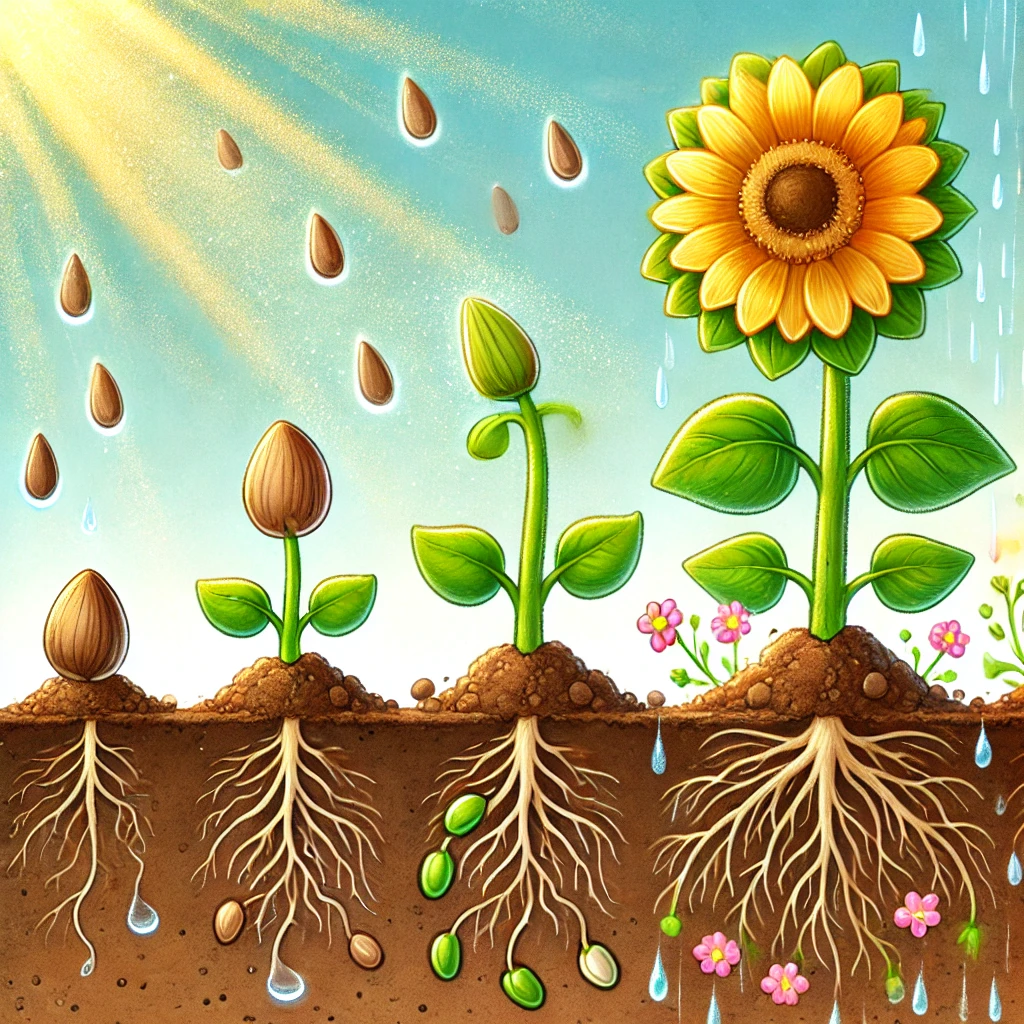
1.Starting Underground:
•Curl up small: “We are tiny seeds, tucked underground. Curl up tight and still, like you are resting deep in the soil.”
•Wiggle slightly: “The soil around us is warm and cozy. We wiggle a little as we feel the earth holding us.”
2.The Seed Awakens:
•Stretch fingers and toes: “The rain begins to fall, and the water wakes us up. Our roots start to stretch out, slowly reaching down into the soil. Stretch your fingers and toes like little roots.”
3.Growing Roots:
•Reach down low: “Our roots grow longer and deeper, searching for water. Reach your arms down toward the ground as your roots grow.”
4.Breaking Through the Soil:
•Lift your head: “Now, we start to push up toward the light. Lift your head slowly as the seed begins to sprout.”
5.Reaching for the Sun:
•Stand up tall, stretch your arms: “We are breaking through the soil! Our leaves reach up toward the sky to catch the sunlight. Stretch your arms high as we grow taller.”
6.The Sun Shines:
•Sway gently: “The sun is shining on us, helping us grow. Feel the warmth of the sun as we sway in the gentle breeze. Sway side to side like a plant growing in the wind.”
7.Blooming:
•Open arms wide: “We are growing more every day, and now we bloom! Our petals open wide, stretching out as we become a beautiful flower. Open your arms as wide as you can.”
8.Enjoying the World:
•Spin gently: “Now we are tall and strong. We spin slowly to show our beautiful flower to the world. Spin gently in place.”
9.Spreading Seeds:
•Pretend to scatter seeds: “Our flowers are full of seeds now. We let the wind carry them to new places, ready to start the cycle again. Scatter your seeds gently.”
10.The Plant Begins to Fade:
•Droop your arms slowly: “But now the days are getting colder, and we’ve grown old. Our leaves start to droop. Lower your arms as your body becomes tired.”
11.Withering:
•Slowly bend down: “We’ve had our time in the sun, but now we are fading. Our stems start to bend, and we lower ourselves toward the ground. Slowly bend your knees and body until you are close to the earth.”
12.Returning to the Earth:
•Lay down or curl back up: “We fall to the ground and rest, becoming part of the earth once again. Curl back up, resting quietly like we did at the beginning.”
13.New Seeds Begin Again:
•Lift your head slightly: “Even though we have returned to the soil, new seeds are getting ready to start their own journey. And so the cycle continues.”
Conclusion:
You can end with a reflection, asking the children how they felt going through the whole life cycle of the plant, from birth to death. This addition helps children grasp the concept of natural cycles, growth, and renewal in a more holistic way.
Open Ended Questions:
Here are some open-ended questions rephrased from the seed’s perspective, encouraging children to empathize with the seed and reflect on its journey:
1.How did it feel to wake up and stretch my roots for the first time?
2.What do you think I needed to grow strong and tall?
3.Why do you think I had to stop growing and rest in the soil again?
4.What do you think happens to me after I fall back to the ground?
5.How would you describe my journey from a tiny seed to a big plant?
6.What was the best part of my journey? Was it stretching my leaves to the sun or spreading my seeds?
7.Why do you think I kept reaching up toward the sun as I grew?
8.How do you think I felt when I was spreading my seeds to start the next cycle?
9.Do you know any other living things that go through changes like I do?
10.How do you think I felt at different points—when I was resting underground, growing up tall, or falling back down?
11.What do you imagine I was feeling while I was underground, waiting to sprout?
12.If you could help me on my journey, what would you do?
13.What would the world be like if I didn’t grow into a plant?
14.When I was resting underground, what do you think I was waiting for to help me grow?
These questions help children step into the role of the seed, promoting empathy and a deeper understanding of the seed’s life cycle.
