
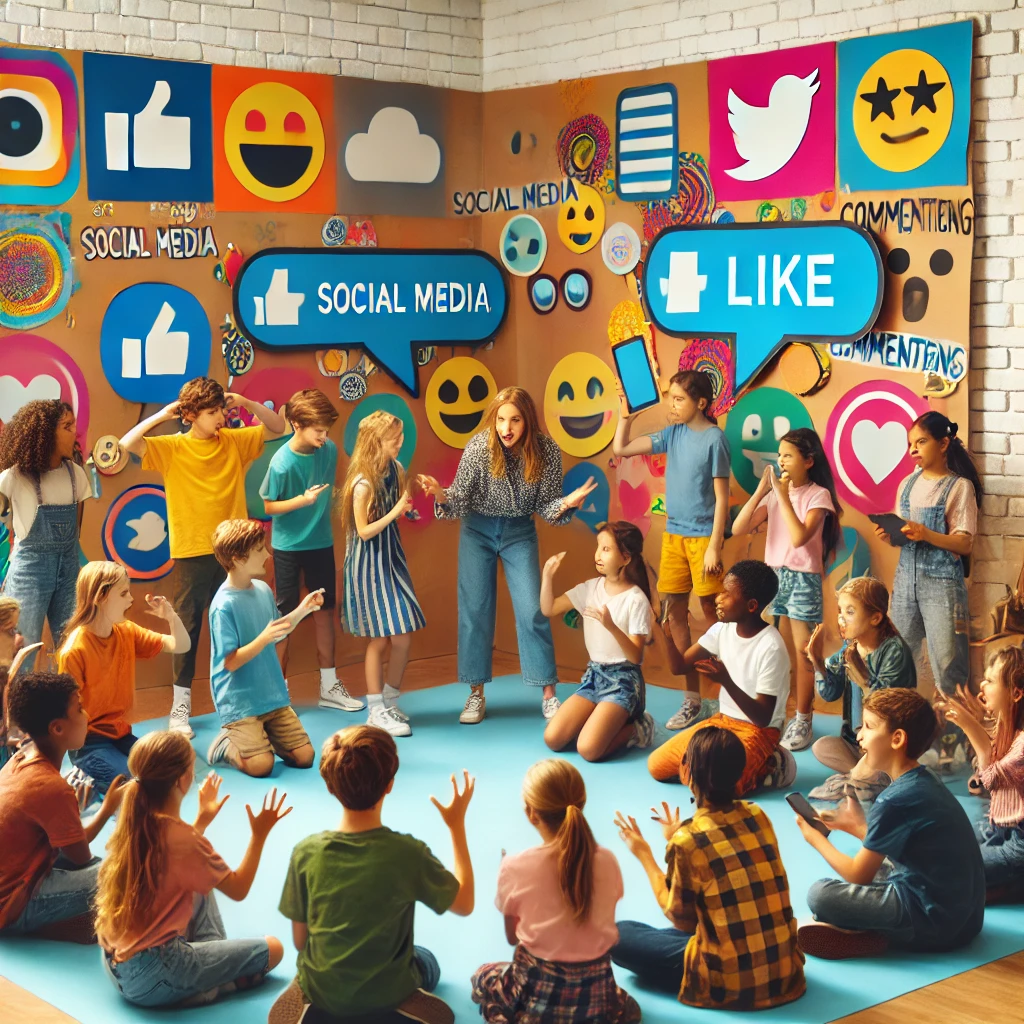
Main Objective: To use naturalistic acting techniques to examine the issues surrounding social media use and its impact on relationships and self-image.
Sub aims: – To explore body language and online personas in the digital age
– To identify and enact human responses to social media interactions
– To work in groups to create and present drama scenes on social media themes
Materials: An empty space, chairs, and optionally, cardboard cutouts of smartphone frames
Check In: At the beginning of the session, the facilitator invites participants to offer a brief, individual response about how they are feeling (physically/emotionally) or what they are looking forward to regarding their work together. This strategy recognizes that affect (body, emotion) and intention shape how an individual participates in the learning environment, particularly when the exploration involves physical or emotional risk-taking by the participants.
Warm Up: SCROLL IT, POST IT
Mingle around the room, mimicking scrolling on a phone and acting out different social media user types:
– INFLUENCERS – pose, take selfies, and call out to imaginary followers. Pair up on command: 30 seconds to describe your latest sponsored post.
– LURKERS – quietly observe, occasionally nod or shake head. Pair up on command: 30 seconds to whisper about something interesting you saw online.
– DEBATERS – gesture animatedly, as if typing furiously. Pair up on command: 30 seconds to argue about a hot topic.
Character Development: In groups, participants create a character based on a social media persona. Each group can explore different types such as:
- The “Influencer”
- The “Troll”
- The “Oversharer”
- The “Lurker”
- The “Activist”
- The “Debater”
Instructions: Each group writes a short bio for their character, including their online and offline behaviours, motivations, and struggles. They can create details like hobbies, preferred platforms, and goals.
Presenting: Groups introduce their character to the rest of the class in a short scene.
Snapshot
Divide participants into groups of three and give each group one of the following prompts to create a still image (tableau). Each tableau should depict a social media-related moment. After each group presents, discuss body language, focus, and the dynamics in the scene.
Examples of Snapshots:
- Reacting to Going Viral:
- One person excited, another overwhelmed, and the third confused. How does the body language show the range of emotions from validation to anxiety?
- Discussion Prompt: What did you notice about how going viral can affect people differently? What does this say about the desire for visibility?
- Friend Group Taking a Group Selfie:
- How does everyone position themselves in relation to the “camera”? Who tries to be in the front? Who is more disengaged or passive in the background?
- Discussion Prompt: What body language suggests the hierarchy in this scene? How does this reflect online personas?
- Dealing with Online Criticism:
- One person reading critical comments on a phone or laptop, while two others react with varying levels of empathy or judgment.
- Discussion Prompt: How do different characters respond to online criticism? How does this shape their relationships in the real world?
- Scrolling Through Posts at a Party:
- One person engrossed in their phone, ignoring the others at the party. Another person looks over their shoulder, interested or judgmental, while a third character is frustrated.
- Discussion Prompt: What does this tableau tell us about how social media can affect in-person interactions?
- Celebrating a Milestone (e.g., 1,000 followers):
- One person is ecstatic and poses as if taking celebratory photos, while the others either share in their joy or react with jealousy or indifference.
- Discussion Prompt: How do body language and facial expressions reveal social status and dynamics?
- Unfriending or Unfollowing Someone:
- One person is shown clicking the “unfriend” or “unfollow” button while another reacts emotionally in the background (angry, hurt, or relieved).
- Discussion Prompt: How does body language reveal the impact of digital actions on real-life emotions?
- Comparing Yourself to Someone’s Curated Feed:
- One character looks at their phone in distress, comparing themselves to an idealized, edited post of a friend or influencer.
- Discussion Prompt: What does this image say about self-esteem and self-image in the digital age?
- Caught in a Controversy:
- One character is shown as a content creator embroiled in an online debate or scandal. Two others react: one defending them, the other attacking or criticizing.
- Discussion Prompt: How does the physical arrangement of the tableau show who holds power or status in the situation?
- Online Support Group or Positive Feedback:
- A person is surrounded by others offering supportive gestures (hugs, thumbs up) while they read kind comments on a screen.
- Discussion Prompt: What impact does supportive online feedback have on an individual’s posture, mood, and self-worth?
- Reading “Likes” and “Follows” After Posting:
- One character anxiously refreshing their phone, while others look on either in encouragement or indifference.
- Discussion Prompt: How does the expectation of social validation manifest in body language? What happens when it’s not met?
- Selfie Culture Gone Wrong:
- Someone precariously taking a selfie in a dangerous or awkward location (e.g., on a ledge, while driving). The others react with shock or fear.
- Discussion Prompt: How does this image reflect the extremes people might go to for validation? What commentary does this offer on social media influence?
- FOMO (Fear of Missing Out):
- One character scrolls through a party post on social media, feeling left out, while others are present at the event, oblivious to their feelings.
- Discussion Prompt: How does social media amplify feelings of exclusion and insecurity? What clues do you see in the characters’ body language?
- Group Chat Drama:
- A group gathered around their phones, reacting to a controversial message in a group chat—some laughing, others upset, one person typing furiously.
- Discussion Prompt: How do online conflicts or jokes escalate in ways that might not happen face-to-face? How do characters position themselves when navigating online drama?
After Each Presentation:
Discuss the body language, facial expressions, and positions of characters:
- What differences did you see in the body language when portraying the various scenarios?
- How does the “digital” nature of these interactions affect posture, proximity, and expression?
- What roles did levels, angles, and character proximity play in enhancing the drama of the scene?
Main Focus: Social Media Status
Pair work: One person brings out a chair and sits on it, pretending to scroll on a phone.
Show a tableau of an influencer (standing) demanding a fan (sitting) to like and share their content. Upon instruction, bring the scene to life with the line, “If you’re a real fan, you’ll share this right now!”
Swap roles: the tableau is of a troll lounging on the seat and the other person arriving to find their post has been targeted with negative comments. Upon command, bring the scene to life with the line, “Hey, why are you saying these things about me?”
Lightning looks: Have all pairs play at once. Freeze them and activate one or two pairs at a time to take lightning looks at their scenes. Talk about body language and status in the context of social media. Look at how online status is conferred. Replay. Ask some partnerships to replay the scene, but as characters of equal social media status.
Discuss:
– What are the high-status characters doing with body/voice/choice of language/positioning to claim status?
– What are the low-status characters doing to bestow status?
– What difference do you see when they are played at equal status?
– How do a character create images of social media status?
– When/where do you see this happening in real online interactions?
‘Human Algorithm’ scenarios:
Each scene begins with others acting as a social media feed. Upon command, the ‘test users’ arrive at their groups. Four variants are played in the following order:
- The arriving party’s post is ignored (no likes or comments)
- The arriving party’s post is criticized.
- The arriving party’s post receives genuine, supportive engagement
- The arriving party’s post goes viral with positive reception
Discuss:
– What was it like to be ignored, criticized, supported, or go viral?
– What emotions do these different responses trigger in real life?
– How did each affect the character’s behaviour (voice, body, dialogue)?
– If this was real life, how would these experiences affect someone?
– In real life, what are some of the reasons why social media audiences respond differently to content?
Human Algorithm Scenario: Extend this exercise by having more in-depth discussions between each variant:
- Reflection After Each Round: Take longer to discuss how different responses (being ignored, criticized, supported, or going viral) affect self-worth and mental health. Discuss how status, visibility, and feedback loops influence behaviour both online and offline.
- Addition: Participants write down the emotions they feel during each variant and then compare in a larger discussion.
Making a Scene from a Story
Small group improvisation:
- Set groups to prepare an improvisation around the title ‘first post’. Distribute different tasks to each group:
– A newcomer to a platform makes their first post and receives a warm welcome
– Someone accidentally posts personal information and scrambles to delete it
– A user’s controversial opinion sparks a heated debate
– A small account’s post unexpectedly goes viral
– Friends discover they have very different online personas
– Parents react to their child’s first social media account
- Allow students time to talk through, cast, and try out their scene.
- Shares the scenes to the class.
Using Poetry as a stimulus to explore social media issues:
NOTIFICATION NATION
Ping! A new like, my heart skips a beat,
Scroll, double-tap, my day’s now complete.
Monday morning, no tags in group pics,
FOMO sets in, need my social media fix.
Tuesday lunch, a troll in my mentions,
Words cut deep, rising apprehensions.
Wednesday night, comparing my life,
To curated feeds, causes internal strife.
Thursday’s post barely gets any views,
Self-doubt creeps in, giving me the blues.
Friday evening, I decide to log out,
Realizing perhaps, what life’s about.
Two days offline, and I start to see,
The person I am, when screens don’t define me.
Alternative improvisation exercise: Each group could improvise the story in the poem. Instead of narrating the story, act out the scenarios described in each stanza.
Guided Digital Detox Visualization
Let’s take a moment to settle into this space and turn our attention inward. Find a comfortable position, either sitting or lying down, and gently close your eyes. Take a slow, deep breath in through your nose, feeling your lungs expand, and then exhale fully through your mouth. Let go of any tension in your body as you continue to breathe deeply and steadily.
Now, imagine you’re waking up to a new day—a day free from notifications, messages, and screens. Picture yourself gently placing your phone aside, turning off all devices, and choosing to spend the day entirely unplugged.
Feel the weight lift from your mind, knowing that for today, there’s no pressure to check messages or respond to emails. There’s no need to scroll or refresh. You are free to be fully present in the world around you.
Now, imagine stepping outside into a fresh, open space. It could be a place you love—maybe a park, a beach, a quiet forest, or even your own backyard. The air is crisp and clear, and as you take a deep breath, you feel fully connected to the world around you.
Look around in your mind’s eye and take in the sights—the vibrant colors of nature, the textures of the ground beneath your feet. You hear the sounds of the world—the rustling of leaves, birds singing, the soft murmur of distant voices. These are the sounds and sights we often miss when we’re glued to our screens, but today, you are fully tuned into them.
As you walk through this peaceful space, feel the sensation of freedom—freedom from the pressures of social media, freedom from comparison, freedom from the constant urge to check what’s happening online. Instead, your mind is clear, your heart is calm, and you feel fully present in this moment, exactly as you are.
Notice how good it feels to be connected with yourself and the world around you, without the noise of digital life. There’s nothing you need to prove, no image to uphold, no likes or comments to seek. You are enough just as you are.
As you continue to explore this space, notice how your body feels. Maybe there’s a sense of lightness, of relaxation, or of being unburdened by technology. You are present, grounded, and at peace.
Now, take a moment to reflect on the kinds of activities you enjoy when you’re not online. What brings you joy? Is it spending time with loved ones, pursuing a creative hobby, reading, or simply being in nature? Imagine yourself engaging in these activities throughout the day, feeling fulfilled and content without ever needing to check a screen.
As your day begins to end, you realize how refreshing it’s been to disconnect. You’ve spent the day fully present, and in doing so, you’ve reconnected with what matters most to you. You are reminded that life offline is rich, fulfilling, and meaningful.
Take one last deep breath, savouring this feeling of peace and presence. As you gently bring your awareness back to this room, know that this digital detox experience is always available to you whenever you need it. You can choose to disconnect, even just for a short while, to reconnect with yourself and the world around you.
When you’re ready, slowly open your eyes, and take a moment to stretch or move your body. Welcome back.
Closure: Participants stand in a circle. The group is given a prompt that reflects on what happened. For example: “To end our work, we will offer a group Tweet that explains how we felt about today’s workshop. Each person will offer a word as we make up a tweet together. Our goal is to build on the word and idea that is offered before, keeping in mind the character limit.”
One person volunteers to begin. Each person offers one word each, to collectively build a short tweet. After the group feels a complete tweet has been spoken, everyone energetically says, “hashtag blessed” and does a silly dance move, then steps back into the circle for the next tweet to begin.
The facilitator can do multiple tweets, moving around the circle. The tone and style of these short sayings can vary. They can be inspirational, humorous, or follow a more serious reflective approach.
